People everywhere are reaching for hope, something firm to stand on. Christmas is so much more than wishing for a better world; it’s a symbol of the universal nature of wonder that can transform our lives, brining us hope, meaning, and purpose. The Christmas Eve sermon (2021) is based on Isaiah 9.2-7 and Luke 2.8-20. I also explore than unsentimental gifts of the Christmas classic movie, “It’s a Wonderful Life” and what it shows us about living through this pandemic.
1.
The poetry of Isaiah and the prose of Luke are examples of ways these ancient writers tried to help their people find hope, feel some sense of wonder, and taste a little joy despite the hard times they were living through.
That’s what Christmas aims to do for us tonight and in the days ahead. It’s what Christmas has tried to do for a lot of people facing a lot of challenges throughout the course of history.
Hope. Wonder. Joy. No matter what we’re facing.
2800 years ago in the Middle East, Isaiah’s people were facing a season of life the prophet called days of “gloom and anguish.” Poets writing about our time today, could easily use similar language. Of our days, the young poet laureate, Amanda Gorman, says in her poem, The Hill We Climb:
When day comes we ask ourselves,
where can we find light in this never-ending shade?
The loss we carry,
a sea we must wade. . . .
Yes, our own poets and prophets name for us what we so often feel but often don’t know how to say. Ours is, in so many ways, a time of “gloom and anguish.”
We know what it means to live—what feels endlessly—under the fear of a disease that stalks us, even when we vax against it, a virus that transforms itself so it can keep on stalking us—and us, barely one step ahead of it.
And it’s not just a virus that harasses us, making this a time of “gloom and anguish,” there are the massive political, social, and racial divisions in our society and also among the people in our families and among our friends. There are the environmental threats too. And, add to all this, the escalating tensions between nations, the threat of war and violence elsewhere and even in our streets. And there are the vast economic disparities and injustices that plague us and wound us and keep us up at night.
No one would fault you for using the prophet Isaiah’s words to describe our days as a time of “gloom and anguish.” No one would blame you if you said we are like Mary and Joseph and the shepherds, living in a long night with little hope for the light we need.
2.
But neither Isaiah nor the writer of the Gospel According to Saint Luke left their people to stew in the gloom, or to dwell in the dark.
Isaiah said,
“Light has shined on those who lived in a land of deep darkness. For a child has been born for us, a son given to us.”
The writer of the Gospel said,
“Do not be afraid; for I am bringing you good news of great joy for all the people.”
Both of these writers want us to know that what our minds need when we are in “gloom and anguish,” living in a long, never ending night, is hope; what our bodies need is wonder; what our souls need is joy—precisely the qualities of life that head for cover when we’re under stress, feeling strain.
Isaiah said that the child will be called “Wonder-full.”
The Gospel writer said that “all were filled with awe” in the presence of the child. And they felt joy, despite their circumstances.
These ancient texts are about the universal sign of what a child means to human beings. True, a baby can be a challenge. An infant is work. A little one makes huge demands on physical and emotional resources. But the archetype of the Child is for every human being on the face of the planet a sign of hope, a symbol of possibility, a witness to the irrepressible power of life. Around a child, vulnerable, needy, and fragile, human beings, universally, feel a sense of hope, wonder, and joy. It’s only the callous among us who don’t, or those who are out of touch.
I don’t know what you’re facing this Christmas. I don’t know how well you’re holding off the stress of the world’s tribulation this Christmas. Maybe you’ve found a way to cocoon yourself. But most of us can’t. Most of us are feeling the stress and strain acutely.
We’re looking for hope, searching for wonder, aching for joy.
3.
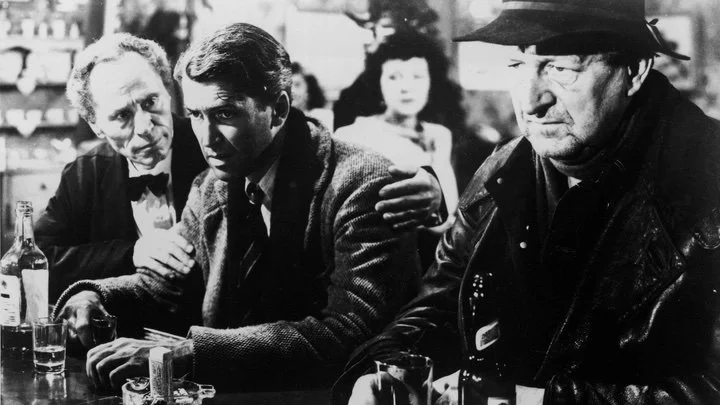
This year is the 75th anniversary of the perennial Christmas favorite, It’s a Wonderful Life, a movie starring Jimmy Stewart and Donna Reed. I watched the movie on Monday. It had been years since I’d seen it last. I wonder why I returned to it this year. I wonder, given all we’ve been through the last couple years, all I’ve been through, if there was something in me that needed the reminder that wonder is what I need now, especially because it feels so uncommon.
You probably don’t know, I didn’t know, that the daughter of Jimmy Stewart lives just outside of Davis. Kelly Stewart Harcourt is an anthropologist; she studies human behavior. And she says that her father’s movie, It’s a Wonderful Life, has an important message for our times.
“It is about decency and honesty,” she told ABC Channel 10 in a recent interview. “But it's also about sacrifice. The major cloud over our lives today is the pandemic.” In a time like this, when most of our lives are not what we want them to be right now, my dad and Donna Reed would say to us something like: Look, it’s hard. You probably want things to be different. We get that. But your work right now is to make “the life you have, with the people you have around you, mean something.” You are to make something wonderful with the life you have, with what you have, with who you have around you, even if it’s just a few, and maybe not even the ones you most want. You and I are to make a wonderful life.
That doesn’t mean it’s a life of ease or comfort or calm. That doesn’t mean you’re getting the life you always thought you wanted. It means you’re making a life of wonder with the stuff life gives you.
4.
That’s exactly what the prophet Isaiah and the writer of the Gospel According to Luke would tell us to do. They’d say,
Look. It’s hard right now. We get that. It was hard for us too. We said what we said then to people who wished for a life they weren’t living; they wished for a life that wasn’t full of the challenges and stresses assailing them. But there was no escape; the way forward was through the things they had to do.
We wrote to give them hope, to point them in the direction of joy.
For life is never devoid of wonder for those persistent enough to find it.
Be persistent.
Be brave.
And make the life you have mean something.
Your life is, whether you can see it or not, a “wonderful life”—more wonderful than you’ve ever dared to imagine. The Child of Christmas is an invitation to wonder, and holds the power to transform your life and the life of our world.