
Companionship's part and parcel of the nature of God and key to your own journey

I'm beginning a new series of posts on companionship and the spiritual journey.  Here's the first of a handful of coming posts.  Please share them with those you consider companions on your journey into the fullness of God.

No one can take this journey for you. The journey into the fullness of God is yours—start to finish. Setting out has energized you, and following the Light you’ve glimpsed is the one thing you know you must do. To some degree you may fear this journey into the unknown, but you fear more staying put, staying where you were, stuck in the rut that’s been your life up till now.

The journey toward God is yours to take, but that doesn’t mean you have to walk it alone, nor should you.

It’s true, some have made this journey into union with the Beloved by walking a solitary path. Monastics and hermits in every spiritual tradition are witnesses to the way of utter renunciation. By liberating themselves from just about everything, even human relationships, they’ve walked a long and grueling ascent into the bliss of the unmediated presence of the Divine.

But it’s equally true that the deserts and mountaintops also own the bones of so many more who’ve tried this lonely path and failed. Frankly, most of us need companions along the way—for this journey is not entirely safe, nor is it easy.

Companions aren’t a mere crutch for us who are made of lesser stuff than those spiritual elites.

No, companionship’s part and parcel of the very nature of God.

To be continued . . .
The fruit of prayer: compassion

Ilia DelioPeople often dismiss the contemplative life, the praying life, as disconnected from the realities of daily life. That's a terribly naive and myopic assessment.  This site is dedicated to a robust and compassionate life lived in public, sourced by Divine power.

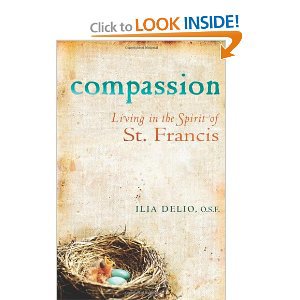
Here's a recent book I've come across...an important work on the relationship between the contemplative and active life.  Contemplation ought to lead to the deepest forms of involvement in daily life--especially the struggle for all to live well on this increasingly trouble, yet beautiful planet.

"The key to compassion is conversion of self; prayer enkindles the grace of conversion. As Francis prayed, he became more deeply attuned to the experience of God in his own life which in turn deepened his compassion for others. Through prayer Francis reached the deepest oneness with God; he realized this oneness by sharing in the human poverty and humility of Christ. Compassion transformed Francis into another Christ 'because of the excess of his love.'"

There's a growing emergence of compassionate folks whose acts are sourced by prayer.  You're among them.

For stuff about the book, click on the image.

Prayer is a descent into our true humanity

Prayer is no flight into the extraordinary; it's a descent into true humanity. It's a union of heaven and earth, the sanctifying of the ordinary--the ordinary recovered by God, paradise regained. Prayer, the prayer that follows the impulse of love, that works to forget all else but God, is the reunion of my self, the reintegration of my being. Prayer is not about getting things from God, calling on God to toss me a life vest. Rather, it's the hard journey past all the alluring things that claim me, call me from the path. Prayer is true freedom, which is why prayer is a way of life and not a mere task or duty.

Finally human: maturing in the life of prayer

Abiding in love is the fruit of years of spiritual practice. There’s no shortcut to this experience of full union with God in Christ through the Spirit, nor is there any way for you to bring yourself here. It comes to you. You become “a partaker of the divine nature” (2 Peter 1.4) only because you’ve participated all along the way along with the mischief of God at work in you—through all your joys and sorrows. You’ve finally become fully human, alive to love, and therefore a person in whom all the fullness of God abides (Ephesians 3.19). This doesn’t mean that you will live without suffering or frustration, temptation or even anger. Rather, when you abide in love, you know how to sublimate your reactivity to such things. You can redirect your spirit quickly and re-establish yourself in the current of God’s love.

Learn to savor every step and happiness will come your way

In the desert tradition of early Christianity, there's this little teaching tale that warns us to stay grounded here and now, that is to keep our feet on the ground. "The elder said, 'If you see a young monk by his own will climbing into heaven, take him by the foot and throw him to the ground, because what he is doing is not good for him.'”

Likewise, resist the temptation to be somewhere other than where you are, especially some illusion of a better life that's not rooted in the reality of your own present life.

Instead, draw into your body the gifts that are coming to you from God today.  You might have to look hard and discerningly, but they're there, all around you, "If you have eyes to see and ears to hear".  Keep your feet on the ground, walking the path of your own life, feeling life as you're living it: the seams in the tile beneath your feet, the sponginess of the carpet in your office at work, the hot asphalt in the parking lot.

Then with each step, your toes and soles will grow increasingly familiar with the ground beneath your feet, for God has said it’s “holy” (Exodus 3.5).

The more you learn to savor every step, the more you’ll find yourself awake to the presence of God.

And happiness will come your way.