The Mixed Life--Activity and Spirituality

We'll be better off if we don't divide what God's joined together.  In Christ, God joined divinity and humanity, the sacred and the ordinary.  By doing so, all of life is made holy. Ours is to be a mixed life.  Finding the sacred in the midst of every day life and experiencing the common life we share as a sacred gift. Recently, a woman approached me after a talk I gave and said, "I'm called to the mixed life, but I don't know what it looks like."

She is searching for a workable combination of contemplation and action–”The Mixed Life” in the language of 14th century Christian mystic, Walter Hilton.

Here's a video meditation on the path we might walk.  It includes some practical tips for practicing an active spirituality.

Dry Heave Spirituality

I was at a church board meeting the other night. What's worse, I led it (I'll tell you what that means in a moment). Here's a circle of busy, competent people, who, because they are busy and competent get asked to do just about everything. And as churches do (and just about every other volunteer organization), we found ways of asking them to do more. We needed a few volunteers for another task force, and few others for a weekend volunteer activity. Those that didn't dive into their calendars to try to find some legitimate way to say "no" simple stared at the papers in front of them.

They are all good people who want our congregation to do good things and know that requires involvement. When they have to say "no" they feel guilty. When they say "yes" they feel the draining weight of yet one more thing to attend.

This creates what I call "dry heave spirituality."

Not a pretty term, I know. But maybe it's shock value will awaken us to what we do to ourselves...to each other.

And here's what I meant by "what's worse, I led it." There comes a point when someone's got to say "enough." It would be nice if leaders like me could recognize in others the tell-tale signs of "dry heave spirituality". But we get blinded by the needs of an organization that require human resources.

Learning to speak a good "no" or "yes" means learning to stay near the center spiritually so that you and I know in our guts when we simply can't do another thing because to do it would violate something sacred within us. When we choose to act from the center there's a wholly/holy different experience.

This takes poise. Internal clarity. Conviction. Courage. We must breath. Seriously. By breathing, we slow down and come back into our bodies, aware of what's going on inside. And our breathing becomes a prayer that unites us with God who's within each of us.

It takes this kind of attentiveness to our lives from the inside-out so we can learn to sense when we're getting spiritually sick.

This kind of awareness can empower:

1. us to say "no" when we must not say "yes"

2. us to say "yes" when we can do so with wind at our backs

3. us who, like me, lead organizations to look out and see signs of dry heave spirituality in others even if they can't recognize it yet themselves.
The Ecstatic Faith of Rumi

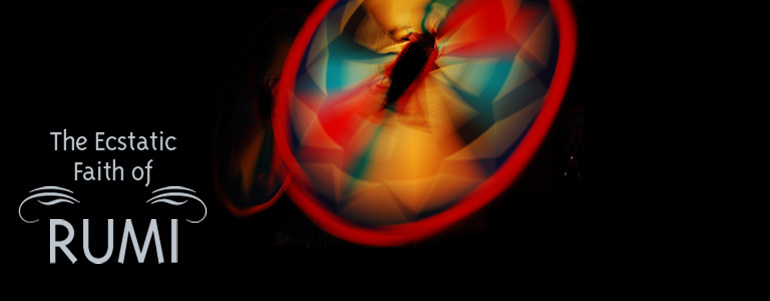
Following up on yesterday's post about Samir Selmanovic’s new book, "It's All About God" What can we learn from those who pray from within another tradition?  How do the mystics transcend the God-boxes of religion, while living fully and freely and unashamedly from within their traditions?

The 13th-century-Persian-Sufi-mystic (jeez, too many adjectives!), Rumi, is one of those.

RumiHere's one who can help us transcend the resurgent religious wars of this 21st century.  And here's a podcast interview between Speaking of Faith's Krista Tippet and  Dr. Fatemeh Keshavarz.  A delightful romp with Jalāl ad-Dīn Muhammad Rūmī as professor Keshavarz explores the way Rumi improvises on the Islamic tradition in ways that transcends the divisions of today's world.

Click here for the podcast.  The site includes reading and a video performance of Rumi's poetry.

It's All About God

Ryan Bell's posted an introduction to the new and important book.  Samir Selmanovic's "It's All About God." The conviction that undergirds this site is that the life of prayer, spirituality, is all about God.  Prayer, as our essential relationship with God, transcends religion.  It must if it is to contact God.  I wonder if Samir is one of the emerging voices at this crucial hinge in history who can help us past the apparent impasse of religion and into the Mystery known as God.  So, I also wonder if  Samir's vision might help us foster a fuller spirituality. From the dust jacket: “Samir has written a book that reads like an extended poem; an ode to life. Where others see only the darkness and destructiveness of religion, Samir sees beauty and hope. Where others see only competition and violence, Samir sees synergy and life. And his vision is no simple syncretism; a blending of all religions into one inoffensive ‘smoothie’ of goodness and light. This book is a celebration of postmodern ‘otherness’ of the first order."

I also wonder about the relationship between religion and spirituality.  On the one hand, without the way religions render God to us--the language, ritual, order--what do we really have of God?  And yet, doesn't religion too often box God up too tightly?  Don't the defenders of a particular religion's God too often exclude the other, make the other into an object, a target, and tragically a victim of religious zeal?

Watch Samir talk about his new book, his remarkable journey among the religions, and his vision for our future as religious people seeking God.  Does it hint at the way forward for us?