A Pilgrimage of New Beginnings, Iona, Scotland

with John Philip Newell

The following excerpt is from my forthcoming book, God is Nearer than We Think: How a Pastor, Disillusioned with Religion, Rediscovered the Heart of It All.  It describes my recent experience on a pilgrimage with Celtic Christian scholar and teacher, John Philip Newell, on the Isle of Iona, Scotland (September 2014).  Seven years earlier, I’d visited the island, alone and disillusioned with my pastoral vocation, and spent time among the dynamic members of the Iona Community there.  Since then, my first marriage fell apart, my best friend committed suicide, and my congregation found itself in substantial conflict over the inclusion of gays and lesbians in the life of the church.  Remarried now to Patty, a psychotherapist, I found myself drawn to the island again.  Patty and I experienced the pilgrimage as a threshold of a w/holy new beginning of our work guiding people and communities toward the kind of flourishing God is birthing in our world today—despite the many challenges around us.

Seven years and a few months later, I found myself once again barreling along the A82 motorway through the Scottish Highlands.  The birches were turning yellow.  A few scattered heather, here and there, still held tenaciously onto their purple blossoms.  It was late September, and I was headed once again to the mystic Isle of Iona.  This time I was not alone.  My wife, Patty, was with me.  We were to join a handful of others for a week on the island, a pilgrimage of new beginnings with John Philip Newell, the Scottish poet, peacemaker, and teacher of Celtic spirituality.

This group of pilgrims was made up of a handful of earnest Christian lay people, a pair of theologians, several nuns, a monk, and me, a pastor.  We all held two things in common: a disillusionment with what has become of Christianity, and deep longing for its rebirth, a hopefulness that it can and will be reborn.  

Iona has a way of gathering women and men like this.  There’s a spiritual magnetism to the island.  For fifteen hundred years Christian pilgrims have found their way to this rocky outcrop on the western edge of Scotland—what some call the “spine of the Atlantic,” because here, geologically speaking, some of the oldest rock on the planet is exposed to the light.  Here, Lewisian gneiss, some two and a half to three billion years old, holds itself, unflinchingly, naked before the elements.  Most of those who come to the island are unaware of this.  I was, until my wife insisted on carrying home a small boulder of this gneiss, grayish-green, with white swirls.  Curious, I inquired about the rock and realized what a treasure is it.  Perhaps three billion years old.  Who can get their mind around that?

I think this Lewisian gneiss is part of the island’s magnetism.  There’s evidence that human beings have been coming here for millennia—the Celts and Druids long before the Christians.  The “spine of the Atlantic” gives those who come here something firm—durable, ancient, almost unchanging—amidst the vicissitudes of our daily lives.  From time beyond all memory, those who, while disillusioned and seeking a way forward, have nevertheless found strong material and spiritual support here upon these ancients rocks that have endured so much change and been so unthreatened by it.  It’s little wonder that in our modern world, pilgrims still seek out this isle of ancient rock and find inspiration here.  Drawn here by their many questions, their discouragements, and their deep longings, we are part of what God is doing to rebirth an expression of life that not only fosters the flourishing of human life, but also the flourishing of the earth itself—a way too often lost among our tired and fractured religious organizations, and among our broken and discouraging political institutions.  

My wife carried a hunk of this Lewisian gneiss home from Iona (actually, I carried it for her).  It's a reminder of our pilgrimage of new beginnings; our shared dream of a Christianity reborn and capable of addressing the realities of our 21st century world. 

Injustice must not remain uncontested

I hear many Christians say that the church is not political; “We need to focus on the gospel not on public policy.”

Image by Scott*

Image by Scott*

I cannot read the Bible and the history of Christianity and go along with that. The prophets, and Jesus himself, were passionate about justice.  The church today must rise up, finding courage and freedom to address—from the perspective of the Bible’s vision of the flourishing of all creation—issues of gun control, immigration, the environment, poverty, war, corporate greed, and racism in America, among other things.

I want to be part of a people who are willing to grapple with such things.  Lord knows we won’t all agree.  But agreement isn’t what I’m after as a pastor.  Agreement can be too dull, too insular, too myopic.  What we need is vigorous disagreement, real wrangling with things that matter from inside a covenant community—that is, a people who love each other and seek the truth, loving and appreciating even those with whom they don’t see eye to eye.  In fact, they will love each other because they don’t see eye to eye and know that this is what’s important for helping them stay honest and moving in the direction of what God is up to in our world.

What I want to see in our churches is engagement—honest, open, passionate engagement.  Only out of that kind of wrestling comes a new vision for the way forward.

The Bible itself is our model for this.  The Bible is one great big wrestling match.  Hundreds of voices over a thousand or more years of wrestling with what they see of God and what they see in the world around them.  All of them trying to make sense of it and create a way for genuine human flourishing.

In a recent interview with seminary student, Mickey Jones, Old Testament theologian, Walter Brueggemann, moves us in this direction.  At the end of the interview, Brueggemann sums up a bracing vision for the way people, serious about the Bible and Christian faith, might awaken to God’s summons to live the justice of God: 

“The Gospel is a very dangerous idea. We have to see how much of that dangerous idea we can perform in our own lives. There is nothing innocuous or safe about the Gospel. Jesus did not get crucified because he was a nice man.

The problem with Christianity today is that we’ve made Jesus too nice.  Our churches are too nice.  We’re too nice.  (But there are plenty of grumpy Christians, you say.  Yes, you’re right, but they’re largely grumpy about all the wrong things.)  All the while the world struggles, creation withers, human lives teeter on the edge.  Nicety may well be a toxic and demonic seduction in the American church.

This doesn’t give us license to be jerks.  Joy and generosity ought to characterize our lives, even in the midst of our struggle for all that’s just and good.  We ought to smile, even while we say: “No! That injustice must not continue; it’ll not remain uncontested—not as long as I’m alive.”

Toward a Christianity fit for the 21st century

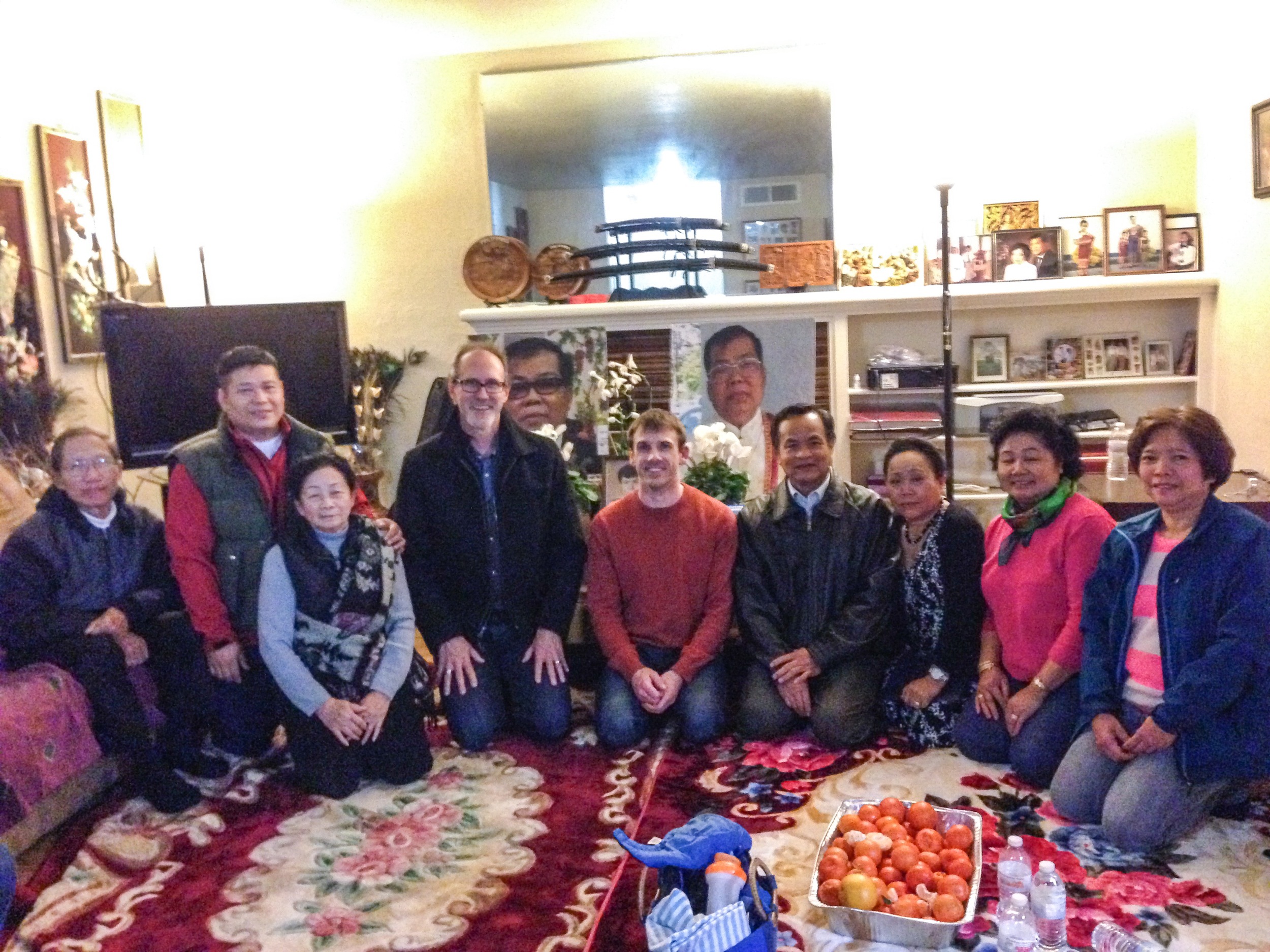
In this picture, I’m with the leaders of our Southeast Asian ministry at University Presbyterian Church: Elder Tony Bounthapanya and Pastors John and Lorna Bosavanh.  Photos of Tony’s father are in the background.  He died after an illness…

In this picture, I’m with the leaders of our Southeast Asian ministry at University Presbyterian Church: Elder Tony Bounthapanya and Pastors John and Lorna Bosavanh.  Photos of Tony’s father are in the background.  He died after an illness the day before.  Laotian culture has a rich tradition of communal life that can sustain a grieving family.  This is day one of three days of mourning.  The home is full of people 24/7, cooking, chatting, praying, laughing, weeping.

Spiritual, political, racial/ethnic, and social pluralism are a reality. For us to thrive on this planet we must learn to get along with each other—in fact, if we are to thrive, we must find the immense good in one another, no matter how different we are from each other.  

This doesn’t minimize our great differences or the trouble those differences can cause us.  Instead, it maximizes a Trinitarian approach to the realities facing us as a global community.  God-as-three-yet-one is a witness to the nature of reality itself—the unity and diversity of the creation, and the insight that if God can get along (God as a unity existing in diversity) than we can too.  In fact, the Trinity is our warrant of wholeness.  It’s why I’m still a Christian despite the foolishness and cruelty of so much of what has often passes for Christianity.  

Embracing the Trinitarian nature of God has an immensely practical application for human life.  We’re made, says the Bible, in the image of God.  That means we are made to celebrate and even enhance our differences, but always with the recognition that we are, nevertheless, one.  Jesus taught this to his disciples: “I ask not only on behalf of these, but also on behalf of those who will believe in me through their word, that they may all be one. As you, Father, are in me and I am in you, may they also be in us, so that the world may believe that you have sent me. The glory that you have given me I have given them, so that they may be one, as we are one, I in them and you in me, that they may become completely one,” (John 20.21-23).

This means that a Christianity fit for the 21st century must value, learn from, and dialog with those not only within the church—and those beyond the Christian household—who see things differently.  A Christianity that will not merely survive the 21st century, but which will thrive within it, must find a way to hold conviction while appreciating and learning from others . . . and then improvising on our inherited tradition in order to promote a way of flourishing that enhances all life on the planet.

How can I be happy?

We all pursue happiness, but it remains so elusive.  Yet happiness is so basic to human yearning.

How can I be happy?

How can happiness pervade my life, lifting me from my preoccupations and from the grumbling that seems to go on inside my head, dragging me down?

Is there something I can do, a simple spiritual practice, available to all, that can open me up to happiness?

David Steindl-Rast, a monk and interfaith scholar testifies that happiness is born from gratitude.

Here is an inspiring lesson in slowing down, looking where you’re going, and above all, being grateful.


A Better Way to Listen: A Prayer for Discernment

Image by tim lowly

As a follow-up to my recent post, Discernment and the Art of Leadership Today, here is a prayer I’ve written and used with groups seeking a way forward when the way is yet unclear: 


Before our thoughts ever wandered down this path,

before we’d said “yes” to this time of discernment,

“yes” to sit down together and talk,

before we knew what was happening—

a new beginning was quietly forming,

for each of us,

for all of us,

and for You and Your divine dream for the world.


So, before we get ahead of ourselves,

before we decide anything,

before we make judgments,

and leap toward conclusions,

we pause at this new beginning

for each of us,

this new beginning for all of us,

this new beginning for You and Your dream for this neighborhood,

and the role we may each play

in its unfolding.


Holy Spirit, enfold us.

Wisdom of God, sit among us.

Word of God, whisper to us

and through us.

Mischief of God, keep us light-hearted.


Help us embrace the gift of this new day.

Help us receive the gift of this present moment.

Help us open our hearts to the wonder 

of time and eternity intertwined.

Let us be grateful.

Let us be attentive,

Help us seek what has never been before

and taste in this moment Your hope for what is yet to come.


So, bless, O God, our Beloved, 

the space between us.

Bless the time we share.

Bless our laughter and our yearnings,

Bless our questioning and our exploring,

that we may each discern this new beginning of Yours,

and Your promise of a new flourishing of life—

a flourishing for each of us,

a flourishing for all of us,

a flourishing for all that is wounded and broken and neglected

among us and around us,

a flourishing for Your people here and everywhere

who are the body of hope, 

the healing presence 

of Jesus in the world.


Amen.


chris neufeld-erdman

November 2014