Toward a Christianity fit for the 21st century

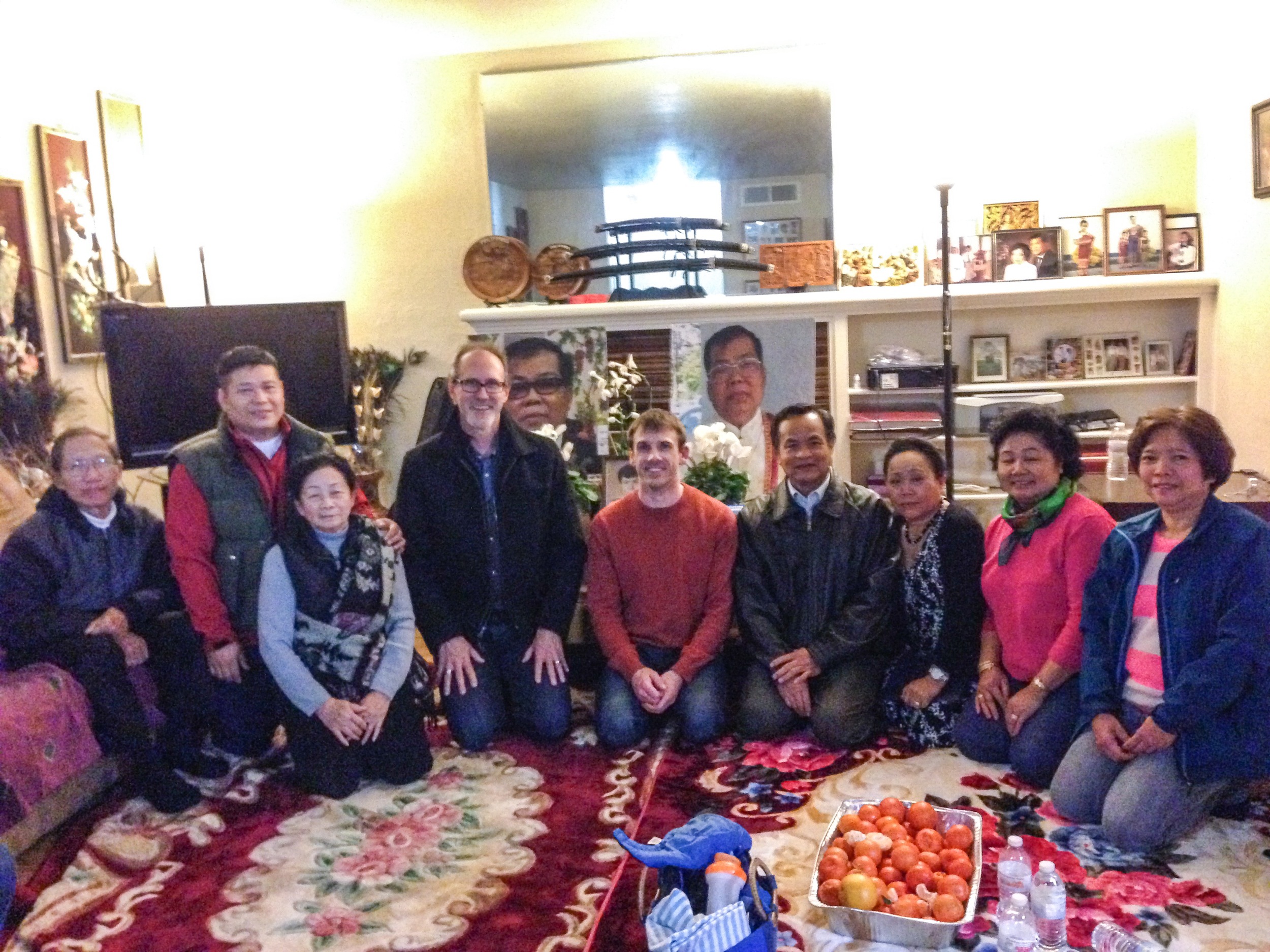
In this picture, I’m with the leaders of our Southeast Asian ministry at University Presbyterian Church: Elder Tony Bounthapanya and Pastors John and Lorna Bosavanh.  Photos of Tony’s father are in the background.  He died after an illness…

In this picture, I’m with the leaders of our Southeast Asian ministry at University Presbyterian Church: Elder Tony Bounthapanya and Pastors John and Lorna Bosavanh.  Photos of Tony’s father are in the background.  He died after an illness the day before.  Laotian culture has a rich tradition of communal life that can sustain a grieving family.  This is day one of three days of mourning.  The home is full of people 24/7, cooking, chatting, praying, laughing, weeping.

Spiritual, political, racial/ethnic, and social pluralism are a reality. For us to thrive on this planet we must learn to get along with each other—in fact, if we are to thrive, we must find the immense good in one another, no matter how different we are from each other.  

This doesn’t minimize our great differences or the trouble those differences can cause us.  Instead, it maximizes a Trinitarian approach to the realities facing us as a global community.  God-as-three-yet-one is a witness to the nature of reality itself—the unity and diversity of the creation, and the insight that if God can get along (God as a unity existing in diversity) than we can too.  In fact, the Trinity is our warrant of wholeness.  It’s why I’m still a Christian despite the foolishness and cruelty of so much of what has often passes for Christianity.  

Embracing the Trinitarian nature of God has an immensely practical application for human life.  We’re made, says the Bible, in the image of God.  That means we are made to celebrate and even enhance our differences, but always with the recognition that we are, nevertheless, one.  Jesus taught this to his disciples: “I ask not only on behalf of these, but also on behalf of those who will believe in me through their word, that they may all be one. As you, Father, are in me and I am in you, may they also be in us, so that the world may believe that you have sent me. The glory that you have given me I have given them, so that they may be one, as we are one, I in them and you in me, that they may become completely one,” (John 20.21-23).

This means that a Christianity fit for the 21st century must value, learn from, and dialog with those not only within the church—and those beyond the Christian household—who see things differently.  A Christianity that will not merely survive the 21st century, but which will thrive within it, must find a way to hold conviction while appreciating and learning from others . . . and then improvising on our inherited tradition in order to promote a way of flourishing that enhances all life on the planet.

How can I be happy?

We all pursue happiness, but it remains so elusive.  Yet happiness is so basic to human yearning.

How can I be happy?

How can happiness pervade my life, lifting me from my preoccupations and from the grumbling that seems to go on inside my head, dragging me down?

Is there something I can do, a simple spiritual practice, available to all, that can open me up to happiness?

David Steindl-Rast, a monk and interfaith scholar testifies that happiness is born from gratitude.

Here is an inspiring lesson in slowing down, looking where you’re going, and above all, being grateful.


A Better Way to Listen: A Prayer for Discernment

Image by tim lowly

As a follow-up to my recent post, Discernment and the Art of Leadership Today, here is a prayer I’ve written and used with groups seeking a way forward when the way is yet unclear: 


Before our thoughts ever wandered down this path,

before we’d said “yes” to this time of discernment,

“yes” to sit down together and talk,

before we knew what was happening—

a new beginning was quietly forming,

for each of us,

for all of us,

and for You and Your divine dream for the world.


So, before we get ahead of ourselves,

before we decide anything,

before we make judgments,

and leap toward conclusions,

we pause at this new beginning

for each of us,

this new beginning for all of us,

this new beginning for You and Your dream for this neighborhood,

and the role we may each play

in its unfolding.


Holy Spirit, enfold us.

Wisdom of God, sit among us.

Word of God, whisper to us

and through us.

Mischief of God, keep us light-hearted.


Help us embrace the gift of this new day.

Help us receive the gift of this present moment.

Help us open our hearts to the wonder 

of time and eternity intertwined.

Let us be grateful.

Let us be attentive,

Help us seek what has never been before

and taste in this moment Your hope for what is yet to come.


So, bless, O God, our Beloved, 

the space between us.

Bless the time we share.

Bless our laughter and our yearnings,

Bless our questioning and our exploring,

that we may each discern this new beginning of Yours,

and Your promise of a new flourishing of life—

a flourishing for each of us,

a flourishing for all of us,

a flourishing for all that is wounded and broken and neglected

among us and around us,

a flourishing for Your people here and everywhere

who are the body of hope, 

the healing presence 

of Jesus in the world.


Amen.


chris neufeld-erdman

November 2014

Discernment and the Art of Leadership Today

Image by John Eisenschenk

Image by John Eisenschenk

Discernment’s an older word that’s making a come back today.  Discernment’s more an art than a science.  That fact may account for its near disappearance during much of the 20th century, when we thought we could do just about anything so long as we had a technique derived from well-applied science.

Today, there’s a recovery of the more soulful arts—not just in spirituality but also in business and government.  In fact, business leaders seem to use more spiritual language than religious leaders often do.  Business leaders talk about corporate and product evangelists; consultants help boards recover a sense of soul; and CEO’s champion the kind of corporate spirit that can not only develop a profitable organization, but also one that can advance the common good

These are challenging times we’re living in.  There’s great pressure on leaders of every kind.  But frankly who among us is really trained to negotiate the cultural white water that we are called as leaders to navigate today?  Technique and method alone can’t carry us forward.  The future belongs to those who have an uncanny ability to know what needs to be done when.  And knowing that isn’t the product of an MBA from Harvard; it doesn’t come by hiring a hot shot consultant.

We often see success in those who’ve not been to Harvard, who do not have a pedigree, some who’ve never been to college.  They seem to have an angle on an inner truth that no school could have helped them find.  

Today’s most successful entrepreneurs seem to live more by Thomas Berry’s vision, “we must dream our way into the future”[ref] than by what they could have learned in business school.  

They have the uncanny ability to access a deeper and spiritual wisdom that translates into the kind of action and products, services and ideas we most need today.

Truth is, the wisdom they’ve found isn’t the purview only of isolated and enlightened individuals.  The wisdom we need often comes best through groups which are committed to the the practice of discernment, opening to the wisdom within us and within each other.  

There is, of course, a great tradition of this within religious communities.  For Christians, the great councils, beginning with the work of the Jerusalem council in Saint Luke’s The Acts of the Apostles (chapter 15), are examples of this.

Jesus himself taught, “Where two or three are gathered in my name, there I Am in there among them” (Matthew 18.20).

So . . . 

Let’s recover the historic practice of sitting together in prayerful openness to God and to each other in order to find our way forward in this time of uncertainty, a time that desperately needs a new creativity arising from deep wisdom;  

Let’s move beyond committee and board meetings where so much that goes on, goes on inside our heads—that is, north of the neck.  Let’s not abolish them, but transform them into communities of spiritual discernment, seeking the common good.  

Let’s commit ourselves to discerning ways forward into what has never been before.  Let’s commit ourselves to innovation because we know that “if we do what we’ve always done, we’ll get what we’ve always gotten.”

The Great Banquet all around us: awakening to gratefulness

I'm preaching on Jesus' parable of the Great Banquet this Sunday, and so, I find myself meditating on: (1) God's abundance around and within us, (2) God's desire that all life blossom into unrestrained flourishing, and (3) all that inhibits us from embracing and experiencing God's invitation to the Feast that is life itself.  

This morning I returned to something I posted last year--September 11, 2013.  And it moved me so deeply all over again.  So, I'm inviting you to experience gratefulness--that essential spiritual practice . . . too often elusive today.   

May the beauty of this artful meditation open your heart to sense the presence and pleasure of the banquet God sets before us each and every moment . . . for "those who have eyes to see".

Here's a TED talk by photographer Louie Schwartzberg, which includes a short film (exquisite) narrated by Benedictine monk David Steindl-Rast. Watch and open your life to Life, experience the truth that "Today is a gift that was given to you, and the only appropriate response is gratitude." See the world again through the eyes of a child and an elderly man.