
Where to find God

A life of prayer that awakens to the essence of the spiritual life---happiness, inner peace, and the most meaningful kind of exterior action in daily life---awakens to the presence of the Beloved within. St. Teresa of Avila heard Christ speak these words: "Teresa, buscate en mi, buscame en ti" ("Seek for yourself in me, seek for me in yourself").

Where do you seek God?  Here in the midst of your daily life, in this moment.

And how?  By awakening to what's within you--the shadows and the radiance.

Prayer, then, is not a pious exercise divorced from daily life.  Nor are you to wander here and there in search for God.  Prayer is life, and life is prayer.  God is near as the beating of your heart, close as your next breath.

Here's God's whisper to Teresa . . . and to you:

Soul, you must seek yourself in Me And Me you must seek in yourself. . . . . You were created for love Beautiful, gracious, and thus In my heart painted, Should you love yourself, O my beloved, Soul, you must seek yourself in Me. . . . . But if perhaps you should not know Where you may find Me Do not go hither and thither, But, if you should wish to find Me, Me you must seek in yourself.

Translated by Raimon Panikkar in Christophany: The Fullness of Man, 2004: 27-28
The spirituality of Trinity or Why you'll be glad to be Trinitarian

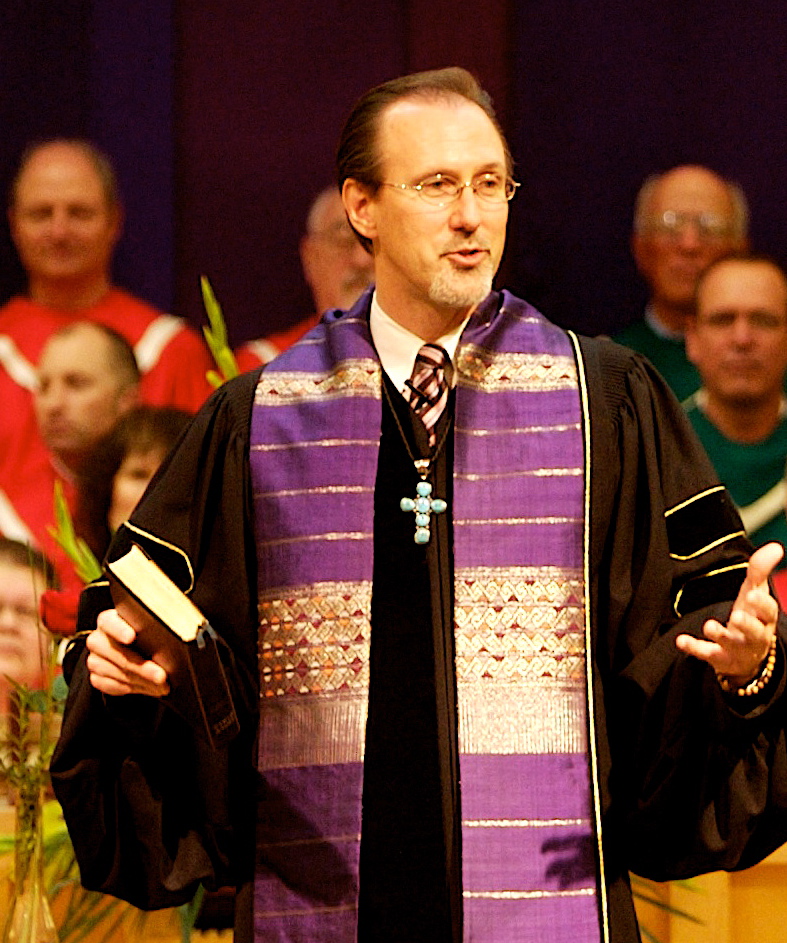
Some of you have suggested posting a link to my recent sermon on the Holy Trinity. IMG_1446_2The Trinity is largely ignored except by those who like to debate doctrine.  But the Trinity is much less about ideas than about direct experience.  In this message I not only explore the ways people have thought about the Trinity, but more importantly  invite us into a trinitarian spirituality that enriches all of life.

If the Trinity has baffled you, confused you, bored you, or even repelled you, you might find yourself opening to the mystery of God as Three, and reveling in a richer spirituality of daily life.

Listen to it or download it here.

Toward a spirituality of management

An example of holy reading, lectio divina, on Scripture, Psalm 104.  It illustrates my meditation and listening early one morning as I readied myself spiritually for the tasks before me that day:

The psalm is a meditation on the goodness of God's creation and praise for God's gracious administration. God sets up the conditions, the environment, but doesn't control us.

How can I follow God's lead as an administrator? I often struggle with the I experience people's performance, their own self-management. I feel responsible for what they do, and can get trapped by my own over-functioning, which is an effort to increase their performance.

Scripture shows me that God may grieve human performance, a person's failure to live into the goodness God has set up for us, offered us. But God never controls us. God gets angry, even demanding (Hosea 11), but backs off again and again, realizing that anger goes against God's own virtues.

Like God---as a servant of God---I can step up the conditions for people to live and work, but I cannot make them perform; in fact, I must not. The genius of human life is that people can find ways of performing that are astonishing---just as they can be immensely disappointing.

This is the splendor of freedom.

Each individual must be given freedom if we are to see their brilliance. Freedom is a risk. You may guide, pray, even sometimes urge, but beware of your own needs and attachments to outcomes. Attached to such things, you will become a tyrant.

So, give them bread (104.15); provide them with water (104.10). Set up the boundaries (104.9). But remember, you cannot make them eat or keep them from wandering.

Your delight is in giving them what they most need---love. What they do with these things is ultimately their business, not yours.

from my journals, October 6, 2007

When you become fire

Here's a poem I wrote in 2009, expresses the intention of prayer.  It joins both the necessity of human effort in the pursuit of God, yet meets our effort with grace---without which there will be no real meeting, no holy fire, no true prayer.  It also joins together the three elements of the person in a fully Christian psychology---body, mind (or soul), and heart (or spirit).

Unless these three unite and meet grace, there is only a superficial meeting with God.  We bring our full humanity to meet God's full divinity.  Only then can we become what we are made to be.  As both St. Athanasius in the Eastern Church and St. Augustine in the Western Church teach: "Divinity became humanity that humanity might become divinity."  This is the goal of prayer---Fire.

The Pyre

Desire Fire, and God will send a spark.

When body, mind, and heart unite,

You become the Pyre.

October 2009

A prayer when entering into silence

It's one thing to offer a prayer expressing your intention to love God in prayer (see previous post). The form of prayer that follows that little prayer may be a meditation on Scripture, holy conversation with your Beloved, or intercession for others. But, at some point Love will invite you into the Silence where no words can ever go.  It is the Silence from which words come, the home of the Word.  To go there, you'll want to express your intention clearly for that journey as well. Here's a prayer I often whisper as I ready myself for stillness before the Beloved:

I still my lips that my mind may seek; I still my mind that my heart may seek; I still my heart, and hide inside the Great Silence, till What I seek finds me.

It expresses my intention to gradually move from the outer parts of my body toward my deepest inner self, where Christ awaits. Such a prayer charts the path I will walk toward the divine encounter, every step a renunciation of self-will, self-interest, and self-control---a yielding to God who alone can carry me across the threshold of what I've known, into the Mystery I cannot know except through the blindness of unknowing, the renunciation of all previous ways of knowing.